

After two years helping wholesale businesses launch and scale their online stores, one question dominates every consultation: which platform should they choose for B2B? Most owners arrive thinking it’s a close call between WooCommerce, Shopify, and BigCommerce. By the end of any honest b2b ecommerce platform comparison, the answer becomes obvious.
Shopify hides its B2B features behind a $2,300/month Plus plan. BigCommerce locks wholesale tools inside custom Enterprise pricing that typically starts at $1,000+ per month. Meanwhile, WooCommerce paired with Wholesale Suite delivers a complete, dedicated wholesale toolkit for $299/year. The price gap alone makes the decision easy, but as you’ll see, WooCommerce wins on functionality, flexibility, and ownership too.
If you’ve already read our WooCommerce vs Shopify B2B comparison, this article expands the analysis to include BigCommerce. For broader guidance on choosing a B2B wholesale platform, we’ve covered that in detail, too.
Quick Verdict: WooCommerce + Wholesale Suite Is the Clear Winner
For independent wholesalers, manufacturers, and distributors, WooCommerce with Wholesale Suite is the right choice in this b2b ecommerce platform comparison. Nothing else combines this depth of wholesale-specific functionality with full data ownership, unlimited customization, and pricing that respects your margins.
Here’s how the three platforms stack up:
| Factor | WooCommerce + Wholesale Suite | Shopify B2B | BigCommerce B2B Edition |
|---|---|---|---|
| Annual B2B Cost | ~$400 to $600/yr | $27,600/yr (Plus required) | $12,000+/yr (Enterprise required) |
| Native B2B on Base Plan | Yes (with Wholesale Suite) | No (Plus only) | No (Enterprise only) |
| Wholesale Pricing Depth | Global, category, product, tiered, unlimited roles | Price lists, company-specific pricing | Customer groups, price lists |
| Dedicated Order Form | Yes (AJAX-powered) | No | No |
| Quote Management | Yes (Wholesale Quotes) | No native system | Yes (B2B Edition only) |
| Payment Terms (NET 30/60/90) | Yes (Stripe-powered) | Yes (Plus only) | Yes (Enterprise only) |
| Data Ownership | Full (you own everything) | Platform-controlled | Platform-controlled |
| Customization | Unlimited (open-source) | Limited (closed-source) | Moderate (headless capable) |
| Transaction Fees | None | Yes (unless Shopify Payments) | None on Enterprise |
If you evaluate all three platforms for wholesale distribution, the cost difference alone is decisive. But WooCommerce didn’t just win on price. Every other axis (features, flexibility, control) tilted in the same direction.
WooCommerce + Wholesale Suite: The Open-Source Wholesale Powerhouse
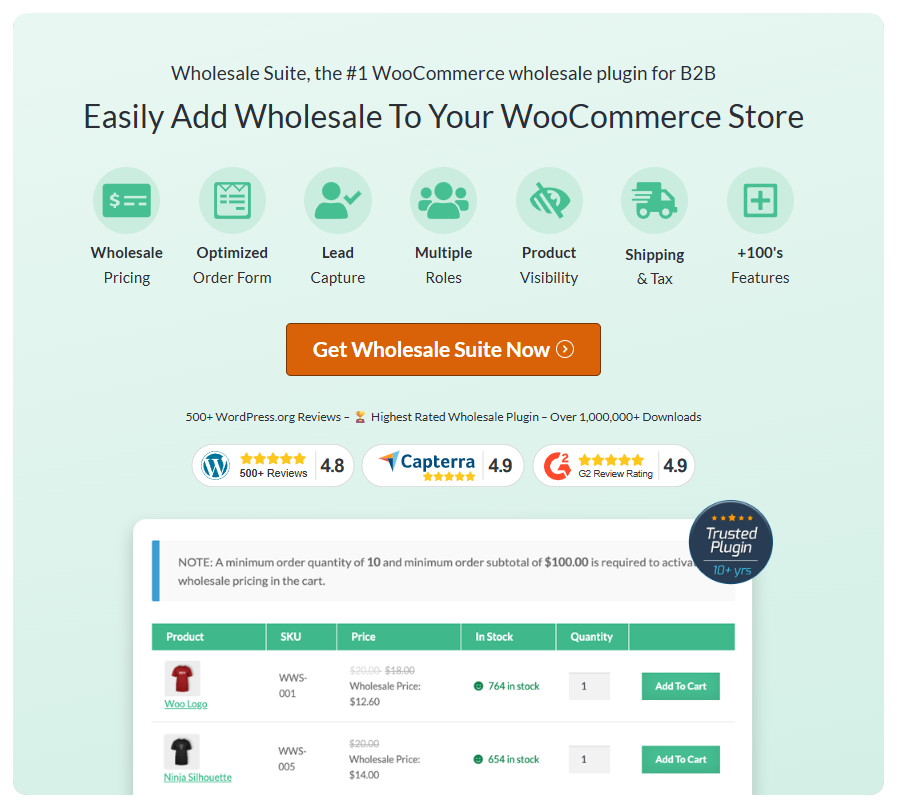
WooCommerce dominates the global ecommerce landscape. According to recent W3Techs data, WooCommerce powers 8.7% of all websites worldwide as of January 2026, while BuiltWith trend data tracks millions of active WooCommerce stores across the internet. The platform is open-source, self-hosted, and free to install. You pay only for hosting and the plugins your store actually needs.
By itself, WooCommerce is a retail-focused platform without native wholesale pricing, B2B registration, or bulk ordering tools. That’s where Wholesale Suite changes the equation, turning WooCommerce into the strongest contender in any serious B2B ecommerce platform comparison.
What Wholesale Suite adds
Wholesale Suite is a modular wholesale solution made up of five dedicated plugins that work together seamlessly:
- Prices Premium: Global, category, and product-level pricing with tiered quantity discounts, unlimited custom wholesale roles, product visibility controls, tax exemption with EU VAT support, minimum order amounts, and role-based shipping and payment gateway mapping.
- Order Form: A dedicated AJAX-powered ordering interface featuring SKU and product name search, category filtering, and instant add-to-cart functionality. Engineered specifically for how wholesale buyers actually place orders.
- Lead Capture: Full registration form builder with custom fields, file uploads for business documentation, approval and rejection workflows, plus customizable email sequences.
- Quotes: Quote request forms, admin approval workflows, in-quote messaging, and one-click quote-to-order conversion.
- Payments: NET 30, 60, and 90-day payment terms powered by Stripe with automatic invoice generation.
Get the Wholesale Suite All Access Bundle, and you’ll see why over 25,000 wholesale stores have already made the switch.
Total cost breakdown
Here’s what year one actually looks like:
- Hosting: $60 to $600/yr, depending on your provider (shared hosting on the low end, managed WordPress hosting on the high end)
- Wholesale Suite All Access Bundle: $299/yr (intro pricing covering all five plugins)
- Total year one: roughly $400 to $600
That’s not a typo. Five dedicated wholesale modules, full platform control, and complete data ownership cost less than what Shopify Plus charges in a single month. Compare that against the closest alternative, and the verdict in any b2b ecommerce platform comparison writes itself.
No re-platforming. No rework. Just adding what is needed, when it is needed. SaaS competitors simply can’t offer that kind of incremental flexibility because their B2B features come bundled inside a single, expensive enterprise tier.
Shopify B2B: Enterprise Pricing For Bolted-On B2B Features
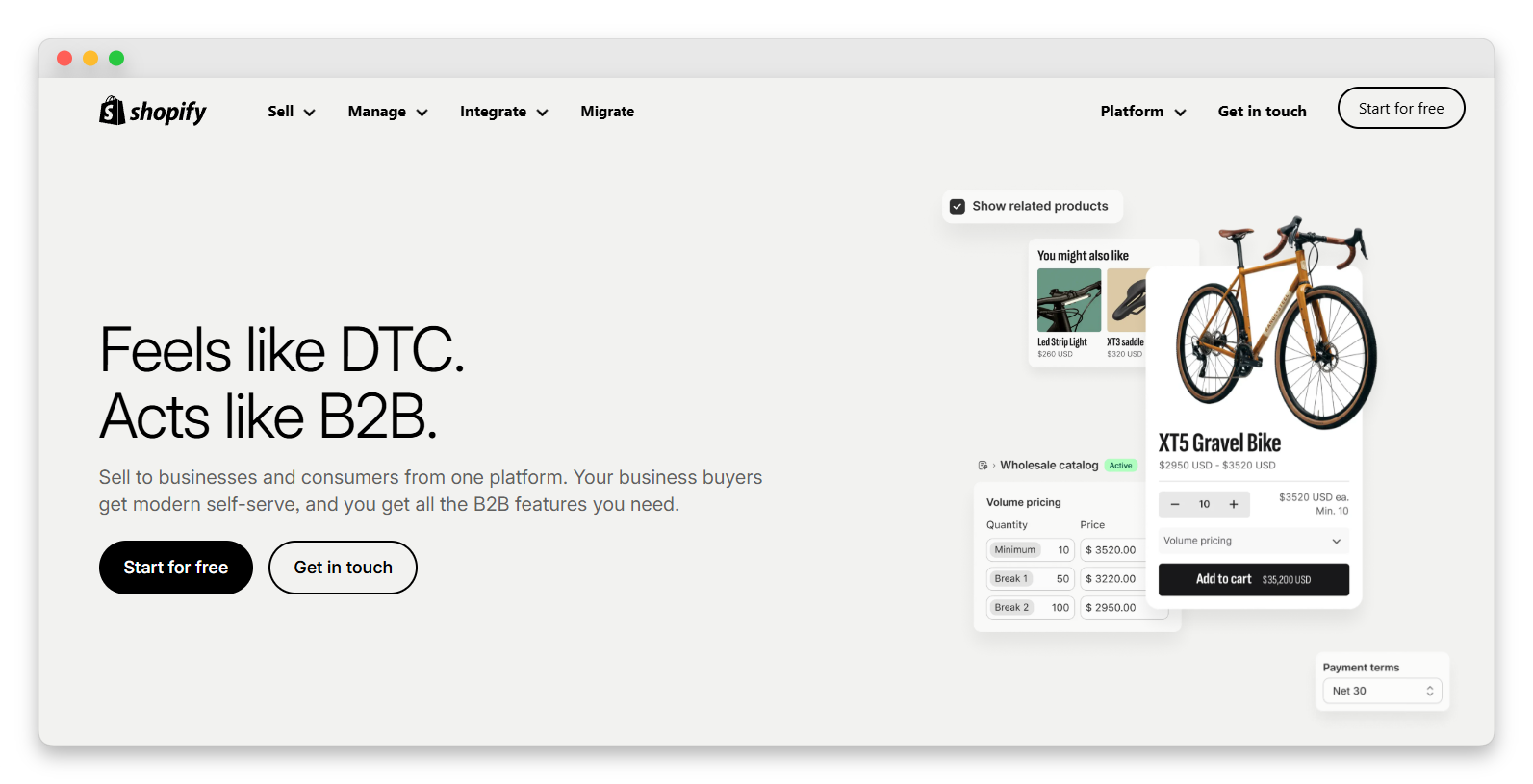
Shopify is widely recognized in retail ecommerce. The platform is fully hosted, easy to set up, and supported by a massive app ecosystem. For consumer-facing stores, it’s a perfectly capable option. For wholesale operations, the picture changes dramatically once you actually run a b2b ecommerce platform comparison on the numbers.
Shopify Plus requirement
Here’s the fact Shopify’s marketing pages don’t put front and center: B2B features are only available on Shopify Plus, which starts at $2,300 per month on a three-year contract (or $2,500/month on a one-year term). That’s $27,600 to $30,000 annually before you add a single app.
Standard Shopify plans ($39/mo, $105/mo, $399/mo) include zero native B2B functionality. There’s no built-in company accounts on those tiers, no wholesale price lists, no payment terms, and no B2B checkout. If you want B2B capabilities on a regular Shopify plan, you’re forced to use third-party apps. Such apps stack monthly fees and integration limitations on top of your platform cost. Industry analysis suggests merchants typically spend an additional $200 to $600 per month on B2B-related apps when running wholesale on standard plans.
What you get with Shopify B2B
On Shopify Plus, the B2B feature set includes company accounts, custom price lists, payment terms, quantity rules, and a B2B-specific checkout. These features work, and Shopify also reliably handles all hosting, security, and platform maintenance. Their admin interface is polished, and uptime has been excellent.
When I reviewed Shopify B2B for a client evaluating platforms last year, the features felt like additions to a retail platform rather than a purpose-built wholesale system. Sure, price lists work. But you don’t get the granularity of per-product tiered pricing combined with unlimited custom roles. There’s no dedicated wholesale order form. Quantity rules exist, but lack the depth of a system designed specifically for B2B from the ground up. Quote management isn’t native at all. Even the wholesale channel functions essentially as a parallel storefront grafted onto consumer infrastructure.
What you don’t get
Customization freedom doesn’t come with Shopify. The platform is closed-source. Every modification has to fit inside their Liquid templating system and app framework. You don’t own your code.
Data portability also takes a hit compared to WooCommerce. Your store lives entirely on Shopify’s infrastructure. Should you ever decide to leave, migrating customer accounts, order history, and custom configurations becomes a real project (Shopify can’t even export customer passwords, for example).
On top of that, unless you use Shopify Payments as your processor, Shopify charges transaction fees on every order. For high-volume wholesale operations, those fees compound fast.
For a deeper Shopify-specific dive, read our detailed WooCommerce vs Shopify B2B breakdown.
BigCommerce B2B Edition: Strong API, Enterprise Price Tag
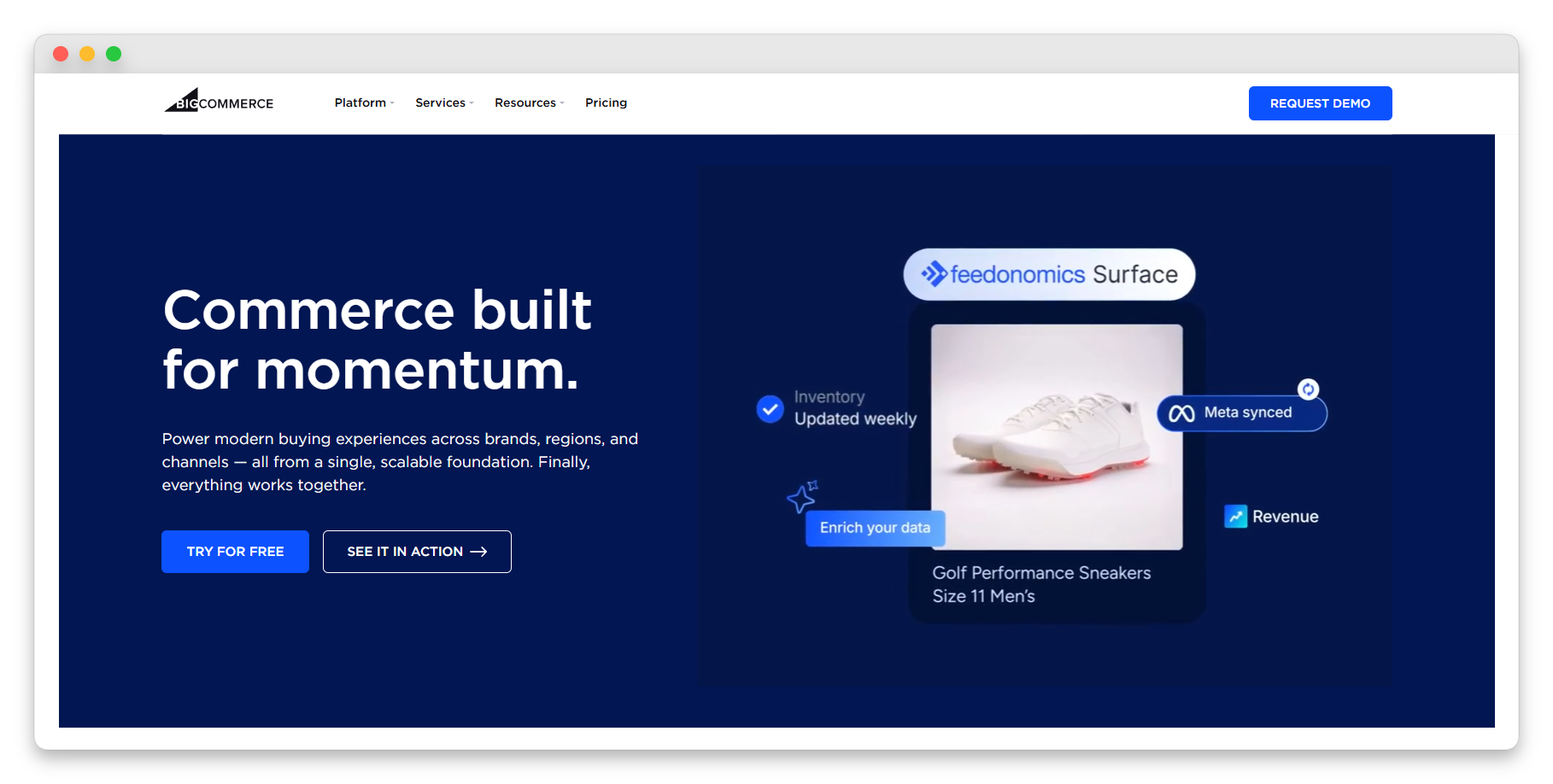
BigCommerce positions itself as enterprise-ready ecommerce with strong multi-channel capabilities. Their B2B Edition targets larger wholesale operations, but the pricing model puts the platform out of reach for most independent businesses.
Enterprise tier requirement
BigCommerce B2B Edition is an add-on to BigCommerce Enterprise, which uses custom pricing that typically starts around $1,000 to $3,000 per month based on your annual GMV. According to industry research, that means a minimum annual cost of $12,000 to $36,000 just for the platform, with B2B Edition itself adding another $6,000+ per year on top of base Enterprise pricing.
Standard BigCommerce plans (Standard $39/mo, Plus $105/mo, Pro $399/mo) offer customer groups and basic B2B capabilities, but the full B2B toolkit, including quote management, purchase orders, shared shopping lists, and the invoice portal, requires the Enterprise tier.
Each BigCommerce plan also has a hard annual sales threshold ($50K, $180K, $400K), and crossing the threshold forces an upgrade to the next tier, whether you need the additional features or not. For growing wholesale businesses, those forced upgrades can hit your budget without warning.
What BigCommerce B2B offers
On the Enterprise plan with B2B Edition, you do get customer groups with tiered pricing, price lists, quote management, purchase orders, shared shopping lists, an invoice portal, and company account management. BigCommerce’s API is genuinely strong, and their support for headless commerce lets you use BigCommerce as a backend while building a fully custom front-end.
Where BigCommerce falls short
The ecosystem gap is the biggest issue exposed by any thorough b2b ecommerce platform comparison. BigCommerce has a smaller app marketplace than either WooCommerce or Shopify. Should you need a niche integration or specific customization, your options shrink fast. Community resources, developer availability, and tutorials are also thinner compared to WordPress’s ecosystem of 60,000+ plugins.
Custom Enterprise pricing also means you’re negotiating with sales reps rather than signing up and getting started. For a wholesale business that wants to test a platform quickly before committing, that sales-driven process creates friction. Revenue-based tier upgrades can also catch you by surprise as your business grows. Higher sales volume can trigger mandatory plan increases, and Enterprise contracts typically lock you into one to three-year terms.
Head-To-Head: Cost Comparison
This is where any honest b2b ecommerce platform comparison gets uncomfortable for the SaaS competitors. The cost difference between these three platforms isn’t marginal. It’s staggering.
Annual B2B platform costs
- WooCommerce + Wholesale Suite: ~$400 to $600/yr (hosting plus the All Access Bundle covering all five wholesale modules)
- BigCommerce Enterprise + B2B Edition: $12,000+/yr (custom pricing, typically $1,000 to $3,000+/mo plus B2B add-on)
- Shopify Plus with B2B: $27,600/yr ($2,300/mo on a 3-year term, before any apps)
Stretch the timeline to three years, and the gap compounds:
- WooCommerce: $1,200 to $1,800 total
- BigCommerce: $36,000+ total
- Shopify Plus: $82,800 total
Across five years:
- WooCommerce: $2,000 to $3,000 total
- BigCommerce: $60,000+ total
- Shopify Plus: $138,000 total
Switching to WooCommerce instead of Shopify Plus saves you over $135,000 across five years. That’s money you could redeploy into inventory, marketing, hiring, or anything else that actually grows your wholesale business.
Hidden costs also stack up on the SaaS platforms. Shopify charges transaction fees (between 0.5% and 2%, depending on plan) unless you use Shopify Payments. For a wholesale store processing $500,000 annually, even a 1% transaction fee adds $5,000 per year in additional costs. WooCommerce, by contrast, has no platform transaction fees whatsoever.
According to Statista’s B2B ecommerce research, the global B2B ecommerce market is now worth tens of trillions of dollars annually and continues growing rapidly. Your platform costs directly affect your margins and competitive position in that market. Paying $27,600 per year for platform access when a $600-per-year alternative delivers more wholesale-specific functionality is hard to justify on any spreadsheet.
Feature Depth: Wholesale-Specific Capabilities
Cost matters, but so does what you actually get. Below is how the three platforms compare on the wholesale features that matter most in any b2b ecommerce platform comparison.
Pricing and discount management
WooCommerce paired with Wholesale Prices Premium gives you global, category, and product-level pricing, along with tiered quantity discounts, unlimited custom wholesale roles, and per-role configuration. You can configure rules like “buy 10+ at 15% off, buy 25+ at 20% off” at the product level while maintaining completely separate pricing structures for different wholesale tiers. Few platforms match this depth of pricing logic.
Shopify B2B provides price lists and company-specific pricing on the Plus plan. The implementation works, but the granularity is more limited. You’re operating inside Shopify’s framework rather than controlling pricing logic end-to-end.
BigCommerce B2B offers customer groups and price lists with tier pricing. Their implementation is solid for standard use cases, but accessing the full pricing toolkit requires the Enterprise tier.
For wholesale-specific pricing depth and configuration flexibility, WooCommerce wins decisively.
Order management
Wholesale Order Form is a standalone product purpose-built for B2B ordering. It’s AJAX-powered with search by SKU or product name, category filtering, inline quantity adjustments, and instant add-to-cart actions. No page reloads. Wholesale buyers placing orders for 50+ items per session notice the difference within minutes.
Shopify B2B uses standard Shopify checkout with B2B features layered on top. While functional, it isn’t purpose-built for high-volume wholesale ordering workflows.
BigCommerce B2B offers purchase orders and shared shopping lists, both of which are useful for enterprise procurement teams. Their ordering experience is competent, but doesn’t match a dedicated wholesale order form for catalog-style bulk ordering.
Quote management
Wholesale Quotes from Wholesale Suite handles the entire workflow: request forms, admin approval, in-quote messaging, public quote sharing links, guest quotes with rate limiting, and one-click quote-to-order conversion. For industries where negotiated pricing is standard, this is a purpose-built solution at no extra cost beyond the bundle.
Shopify B2B does not include a native quote management system. Third-party apps are required.
BigCommerce B2B Edition does include quote management, and the implementation is capable. The catch: Enterprise-tier pricing is the only way to access it.
Payment terms
Wholesale Payments offers NET 30, 60, and 90-day terms powered by Stripe with automatic invoice generation, partial invoice payments, and payment tracking. Stripe integration means you’re not manually creating invoices or chasing buyers for payment. Everything flows through one billing system you already understand.
Shopify B2B includes payment terms on the Plus plan. Solid implementation, but again, only available at the $2,300/month tier.
BigCommerce B2B provides an invoice portal and supports purchase orders on the Enterprise tier.
According to McKinsey’s B2B Pulse research, the vast majority of B2B buyers now expect digital self-service purchasing options. Professional payment terms aren’t a nice-to-have anymore. Buyers expect them.
Flexibility, Data Ownership And Vendor Lock-In
Beyond features and pricing, every wholesale business owner should ask one strategic question: Who controls your store?
Customization freedom
WooCommerce is open-source. Modify any file. Customize any template. Build any feature. The WordPress ecosystem includes 60,000+ plugins, meaning that whatever specific wholesale workflow you need, you can either build it or find it already built. Hundreds of WooCommerce extensions are also available for shipping, payments, marketing, and operations.
Shopify is closed-source. Customization happens within their Liquid templating system and app framework. You can do quite a lot, but boundaries exist. Some wholesale workflows require custom logic that Shopify’s architecture simply can’t support without ugly workarounds.
BigCommerce sits between the two in terms of flexibility, especially with its headless commerce support. Using BigCommerce as a backend while building a fully custom front-end is genuinely possible. Even so, you’re still working inside their API constraints.
Who owns your data?
Pick WooCommerce and you own your database, your customer list, your order history, and your code. Everything lives on your server. Switch hosts? Change developers? Add custom analytics? Nothing stands in your way.
Pick Shopify or BigCommerce, and your data lives on their infrastructure. Both platforms allow data exports, but exports come with limitations. Customer account passwords cannot be exported from Shopify, for instance. Should you decide to leave, migration becomes a project, not a button click.
Platform independence
WooCommerce charges no platform transaction fees. There are no revenue caps forcing you to upgrade tiers. Choose your own payment processor, hosting provider, and email service.
Shopify charges transaction fees on every sale unless you use Shopify Payments. BigCommerce enforces revenue thresholds per plan, triggering mandatory upgrades when sales grow. Both platforms keep control over critical pieces of your business infrastructure.
For wholesale ecommerce operations where long-term independence and stability matter, WooCommerce’s ownership model is unbeatable.
When Each Platform Makes Sense
Shopify Plus B2B
It can make sense when the budget isn’t constrained, and you specifically want fully managed hosting with zero technical maintenance. Large brands already running retail on Shopify who want to add a B2B channel without re-platforming sometimes pick Plus for that reason. You’re paying a premium for convenience and infrastructure management, not for superior wholesale features.
BigCommerce B2B Edition
It can make sense when you specifically need headless commerce capabilities and your development team prefers BigCommerce’s API. Custom front-end requirements combined with an enterprise budget make BigCommerce a viable, if expensive, option.
WooCommerce + Wholesale Suite
This is the BEST option when you want the deepest wholesale functionality at the lowest cost with full control over your store. Independent wholesale businesses, manufacturers, and distributors fit this profile almost perfectly. Five dedicated wholesale modules, hundreds of WooCommerce extensions, and complete data ownership for under $600 a year is hard to beat.
For the vast majority of wholesale businesses, this b2b ecommerce platform comparison points to one answer: WooCommerce with Wholesale Suite.
WooCommerce + Wholesale Suite Wins This B2B Ecommerce Platform Comparison
After comparing all three platforms across cost, features, flexibility, and wholesale-specific depth, this b2b ecommerce platform comparison reaches a decisive conclusion: WooCommerce with Wholesale Suite is the best ecommerce platform for the vast majority of wholesale businesses, manufacturers, and distributors.
Here’s a quick recap of what this article covered:
- Quick verdict
- WooCommerce + Wholesale Suite
- Shopify B2B
- BigCommerce B2B Edition
- Head-to-head: Cost comparison
- Feature depth: Wholesale-specific capabilities
- Flexibility, data ownership, and vendor lock-in
- When each platform makes sense
For a deeper look at the head-to-head against Shopify specifically, read our full WooCommerce vs Shopify B2B breakdown.
Frequently Asked Questions
Is WooCommerce good enough for B2B ecommerce?
Yes, and it’s frequently the best option for wholesale operations. WooCommerce powers a significant share of the world’s online stores, and with Wholesale Suite, it handles wholesale pricing, dedicated order forms, quote management, NET payment terms, and customer onboarding. Over 25,000 wholesale stores already use Wholesale Suite. The open-source model means you can customize every aspect of your B2B workflow, and the WordPress ecosystem provides 60,000+ plugins for any additional functionality.
Do I need Shopify Plus for B2B features?
Yes. Native Shopify B2B features (company accounts, price lists, payment terms, quantity rules, B2B checkout) are only available on Shopify Plus, starting at $2,300/month or $27,600 per year. Lower-tier Shopify plans ($39 to $399/month) do not include built-in B2B functionality. While third-party apps can fill some gaps on lower-tier plans, they add to monthly costs and don’t match the native Plus integration.
How much does a B2B ecommerce platform cost?
Pricing ranges enormously across this B2B ecommerce platform comparison. WooCommerce with Wholesale Suite runs roughly $400 to $600 per year total (hosting plus the All Access Bundle). Shopify Plus starts at $27,600 per year. BigCommerce Enterprise with B2B Edition starts at $12,000+ per year with custom pricing. Across five years, WooCommerce saves you $135,000+ compared to Shopify Plus. Since the feature sets are broadly comparable (WooCommerce wins on most metrics), the cost gap is hard to justify for most wholesale operations.
Can I migrate from Shopify or BigCommerce to WooCommerce?
Absolutely. WooCommerce supports importing products, customers, and order history from other platforms. Numerous migration tools and services exist specifically for Shopify-to-WooCommerce and BigCommerce-to-WooCommerce transfers. The standard process involves exporting your product catalog and customer data, importing it into WooCommerce, and reconfiguring your store settings. URL redirects should also be set up to preserve SEO authority from existing pages. Most migrations complete without significant downtime, and many agencies specialize in this exact workflow.
Which platform is best for wholesale with limited technical skills?
WooCommerce with managed WordPress hosting (from providers like SiteGround, Cloudways, or Kinsta) is straightforward. Managed hosts handle server maintenance, security, and updates so you can focus on your store. Given that WooCommerce saves you thousands per year in platform costs, even hiring a developer for initial setup is cost-effective compared to ongoing Shopify Plus fees.