


The best wholesale items to sell in 2026 include clothing and apparel (40–60% margins), electronics accessories (30–50% margins), beauty products (50–80% margins), and pet supplies (40–60% margins). Success depends on choosing products with consistent demand, reliable suppliers, and margins that cover your overhead. Below, we break down 10 categories with real profit data.
Choosing the right wholesale products is the single most important decision you’ll make as a wholesale business owner. Get it right, and you build a sustainable business with strong margins. Get it wrong, and you’re stuck with inventory that won’t move.
In this guide, we’re going beyond the usual “here are some product ideas” approach. For each product category, we include typical profit margins, startup cost ranges, supplier considerations, and demand trends, the information you actually need to make a business decision!
So let’s get started!
How To Evaluate Wholesale Products Before You Commit
Before diving into specific product categories, here’s the framework successful wholesalers use to evaluate products:
Margin viability: Your wholesale margin needs to cover not just the cost of goods, but also storage, shipping, returns, and overhead. A general rule: aim for a minimum 30% gross margin after all direct costs.
Demand consistency: Seasonal products can be lucrative, but year-round demand provides more predictable cash flow. Check Google Trends for any product category you’re considering — you want a steady or upward line, not a spike-and-crash pattern.
Supplier reliability: The cheapest supplier isn’t always the best. Evaluate suppliers based on minimum order quantities (MOQs), lead times, quality consistency, and return policies.
Competition density: Categories with fewer established wholesale distributors often offer better opportunities for new entrants, even if the total market size is smaller.
Use our free wholesale price calculator to run the numbers on any product before committing to inventory.
10 Best Wholesale Items To Sell In 2026
Now that we understand the importance of choosing which wholesale products to sell, let’s look at some ideas to get you started. Below are 10 products that are most likely to transform your enterprise into a profitable wholesale business!
1. Clothing and apparel
Typical wholesale margins: 40–60%
Startup cost range: $2,000–$15,000
Demand trend: Stable year-round with seasonal peaks (back-to-school, holiday
Clothing remains one of the strongest wholesale categories because of its consistent demand and wide retail audience. The key is finding a niche rather than competing on basics — activewear, sustainable fashion, and plus-size clothing are underserved segments with strong margins.
What makes this category work
Retailers always need fresh inventory, creating recurring wholesale orders. Apparel also has relatively low return rates in wholesale compared to retail.
Supplier considerations
Look for suppliers who offer low MOQs (12–50 units) for initial orders, size run flexibility, and consistent quality across batches. Domestic suppliers typically offer faster turnaround while overseas manufacturers offer lower per-unit costs.
📝 If you’re running your wholesale store on WooCommerce, Wholesale Order Form makes it easy for buyers to select quantities across multiple variants on a single page.
2. Beauty and self-care products
Typical wholesale margins: 50–80%
Startup cost range: $1,500–$10,000
Demand trend: Growing steadily, particularly in clean beauty and men’s grooming
Beauty products consistently deliver some of the highest margins in wholesale. The category has expanded well beyond traditional cosmetics into skincare, haircare, nail products, and men’s grooming — each segment with its own wholesale opportunity.
What makes this category work
High margins, strong repeat purchase rates (products get used up and need replacing), and lower storage requirements than bulkier product categories. Beauty products also tend to have longer shelf lives than food or supplements.
Supplier considerations
Certifications matter in this category — retailers increasingly demand cruelty-free, vegan, or organic certifications. Factor certification costs into your pricing. Also verify shelf life guarantees from suppliers.
3. Electronics accessories
Typical wholesale margins: 30–50%
Startup cost range: $3,000–$20,000
Demand trend: Strong and growing, especially phone accessories and smart home devices
While consumer electronics themselves have thin margins, accessories offer significantly better returns. Phone cases, chargers, screen protectors, earbuds, and smart home accessories are high-volume, high-margin products with constant demand.
What makes this category work
New phone releases and tech product launches create recurring waves of accessory demand. Product lifecycles are short, meaning retailers need to restock frequently.
Supplier considerations
Quality control is critical — defective electronic accessories lead to returns and damage your reputation. Request samples before committing to large orders. Also consider warranty implications.
4. Pet supplies
Typical wholesale margins: 40–60%
Startup cost range: $2,000–$12,000
Demand trend: Steadily increasing, pet owners consistently spend on their animals regardless of economic conditions
The pet industry is famously recession-resistant. Pet owners reduce their own spending before cutting back on their pets, making this one of the most stable wholesale categories available.
What makes this category work
Strong repeat purchase rates (food, treats, grooming supplies), emotional purchasing decisions (owners want the best for their pets), and a growing trend toward premium and organic pet products with higher margins.
Supplier considerations
If selling pet food or treats, you’ll need to navigate regulatory requirements. Non-food pet products (toys, accessories, beds) have fewer compliance requirements and can be easier to start with.
5. Health supplements
Typical wholesale margins: 50–70%
Startup cost range: $5,000–$25,000
Demand trend: Strong growth in fitness supplements, vitamins, and wellness products
Health supplements offer exceptional margins but face higher barriers to entry due to regulatory requirements. If you can navigate the compliance landscape, this category rewards you with loyal, repeat customers and strong margins.
What makes this category work
Consumers who find supplements that work for them tend to repurchase indefinitely. This creates predictable wholesale reorder cycles.
Supplier considerations
Verify GMP (Good Manufacturing Practices) certification, third-party testing, and proper labeling compliance. Cutting corners on supplement quality or compliance can result in serious legal liability.
6. Home decor
Typical wholesale margins: 45–65%
Startup cost range: $3,000–$15,000
Demand trend: Stable with seasonal peaks (spring, holiday gifting)
Home decor spans a wide range — from wall art and candles to throw pillows and kitchenware. The breadth of this category means you can find niches with less competition and strong margins.
What makes this category work
Home decor purchases are often impulse-driven, which means retailers need fresh, visually appealing inventory regularly. Products in this category also photograph well, supporting your marketing efforts.
Supplier considerations
Shipping costs can eat into margins for large or fragile items. Focus on compact, lightweight decor items when starting out to keep logistics simple.
7. Footwear
Typical wholesale margins: 40–55%
Startup cost range: $5,000–$20,000
Demand trend: Stable, with athletic and casual footwear outperforming formal
Footwear requires more upfront investment due to the need for size runs, but the margins and repeat business potential make it worthwhile for established wholesalers.
What makes this category work
Like apparel, retailers need continuous fresh inventory. Footwear also has strong seasonal demand patterns that create predictable ordering cycles.
Supplier considerations
Size run requirements mean higher MOQs. Start with a focused niche (e.g., athletic sandals, work boots) rather than trying to cover all footwear categories.
8. Sports equipment and activewear
Typical wholesale margins: 35–55%
Startup cost range: $5,000–$25,000
Demand trend: Growing, particularly in home fitness and outdoor recreation
The home fitness boom that started in 2020 hasn’t fully reversed — many consumers continue to invest in home workout equipment alongside gym memberships. Activewear follows a similar trajectory.
What makes this category work
Fitness products span a wide price range, from resistance bands (low cost, high margin) to equipment (higher cost, moderate margin). This lets you build a diverse product catalog at different price points.
Supplier considerations
Durability and safety are non-negotiable. Defective fitness equipment creates serious liability. Invest in quality testing and work with suppliers who provide product liability insurance.
9. Jewelry
Typical wholesale margins: 50–75%
Startup cost range: $1,000–$10,000
Demand trend: Stable, with fashion jewelry and personalized items trending upward
Jewelry is one of the most accessible wholesale categories for new entrants because of its small physical size (low storage and shipping costs) and high perceived value relative to manufacturing cost.
What makes this category work
Extremely high margins, low storage requirements, and strong gifting demand that peaks around holidays, Valentine’s Day, and Mother’s Day.
Supplier considerations
Distinguish between fashion/costume jewelry (lower cost, higher volume) and fine jewelry (higher cost, lower volume, more compliance requirements). Starting with fashion jewelry is lower risk.
10. Eco-friendly and sustainable products
Typical wholesale margins: 40–60%
Startup cost range: $2,000–$12,000
Demand trend: Strong growth as consumers and retailers prioritize sustainability
This is the fastest-growing niche in wholesale. Reusable bags, bamboo products, organic cotton goods, biodegradable packaging, and zero-waste kitchen products all fall into this category.
What makes this category work
Premium pricing is expected and accepted by environmentally conscious consumers. Retailers are actively seeking sustainable product lines to meet customer demand, creating strong wholesale opportunities.
Supplier considerations
Verify sustainability claims — “greenwashing” damages credibility. Look for suppliers with third-party certifications (FSC, GOTS, Fair Trade) that back up their environmental claims.
How To Launch Your Wholesale Business Online
Once you’ve chosen your products, the fastest way to start selling wholesale is online. A WooCommerce store with wholesale capabilities lets you reach retail buyers worldwide without the overhead of physical showrooms.
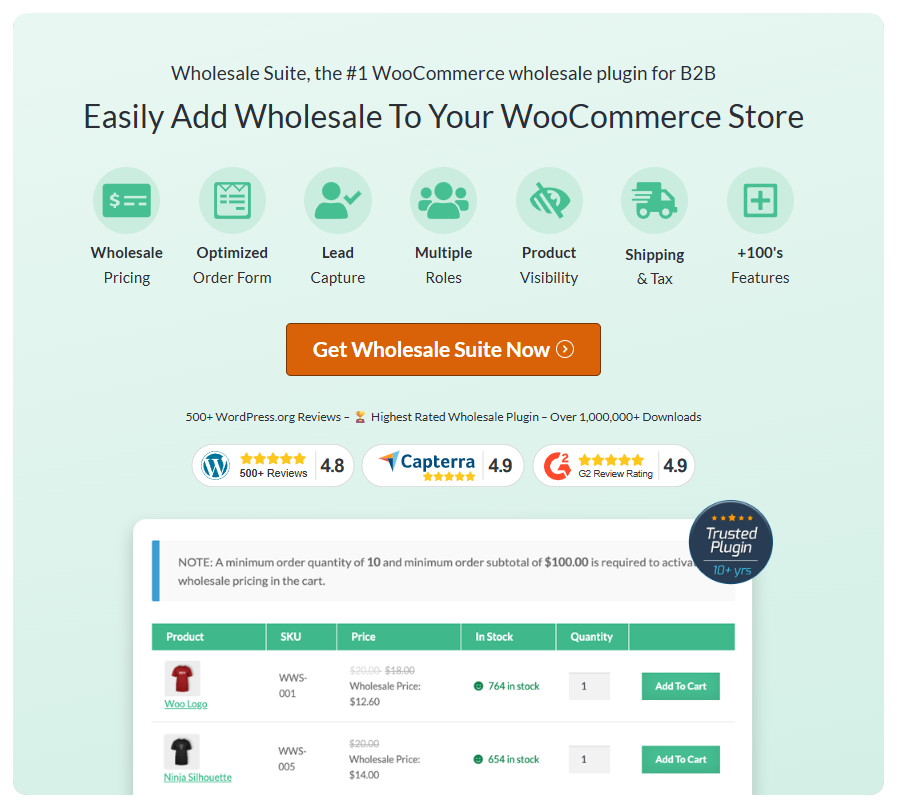
Wholesale Suite is the most popular B2B solution for WooCommerce, used by over 25,000 wholesale store owners. It gives you everything you need to run a professional wholesale operation:
Set wholesale pricing tiers with Wholesale Prices Premium. Create different pricing levels for different customer groups — gold, silver, bronze — with automatic discounts based on order volume.
Create a professional order form with Wholesale Order Form. Your buyers can browse your full catalog and add quantities from a single page, making bulk ordering fast and frictionless.
Automate customer onboarding with Wholesale Lead Capture. New wholesale customers apply through a registration form, you approve or deny them, and they’re automatically assigned the right pricing tier.
Offer flexible payment terms with Wholesale Payments. Support NET 30, NET 60, or NET 90 invoice payment terms — the standard in B2B that retail-focused stores can’t handle.
Calculate Your Wholesale Pricing
Before committing to any product category on these wholesale items to sell, run the numbers. Use our free wholesale price calculator to determine your selling price, or start from the other direction with our wholesale profit margin calculator to see the exact margin, markup, and break-even quantity a given price point delivers.
For a deeper dive into pricing strategy, check out our complete guide to wholesale pricing and our wholesale discount reference guide.
Conclusion
Choosing the right wholesale items to sell means matching your budget, expertise, and market opportunities to product categories that deliver strong margins and consistent demand. The 10 categories above represent the strongest opportunities in 2026, but your success ultimately depends on executing well — sourcing quality products, pricing competitively, and providing a professional buying experience for your retail customers.
Ready to launch your wholesale business? Get started with Wholesale Suite — the complete B2B solution for WooCommerce that handles pricing, ordering, customer management, and payments in one package.
Frequently Asked Questions
What wholesale items to sell have the highest profit margins?
Beauty and self-care products (50–80% margins) and jewelry (50–75% margins) consistently deliver the highest profit margins in wholesale. Health supplements (50–70%) also perform well but require more regulatory compliance. The key is that perceived value drives margins more than manufacturing cost — products where consumers make emotional or health-related purchasing decisions support premium pricing.
How much money do you need to start a wholesale business?
Most wholesale businesses can start with $2,000–$15,000 depending on the product category. Jewelry and beauty products have the lowest entry costs ($1,000–$10,000) due to small physical size and low MOQs. Electronics and sports equipment require more capital ($5,000–$25,000) due to higher per-unit costs and larger MOQs. These figures cover initial inventory only — budget an additional $500–$2,000 for your online store setup, including WooCommerce hosting and a wholesale plugin like Wholesale Suite.
Where do you find reliable wholesale suppliers?
The most reliable sources for wholesale suppliers include industry trade shows (the best way to verify quality firsthand), wholesale directories (Alibaba for overseas, ThomasNet for domestic US), manufacturer direct programs, and industry-specific B2B marketplaces. For a comprehensive list, see our guide to the best wholesale suppliers. Always request samples before committing to large orders regardless of the source.
What’s the difference between wholesale and retail?
Wholesale involves selling products in bulk to retailers or other businesses at a discounted price. Retail involves selling individual products directly to end consumers at full price. Wholesale margins are typically lower per unit but higher in total volume. For a detailed comparison, see our guide on the difference between wholesale and retail.
Can you start a wholesale business from home?
Yes. Many wholesale businesses start from a home office or garage, especially with lightweight products like jewelry, beauty products, or accessories. An online wholesale store built on WooCommerce eliminates the need for a physical storefront or showroom. As order volume grows, you can transition to a dedicated warehouse space. See our guide on wholesale items to sell from home for specific product recommendations.




I’m starting a wholesale can food business in food desert area
Love it Nelton~!
Thanks. Well communicated
Thanks for stopping by Sebastian :)