
“My buyers keep sending purchase orders by email, and I’m copy-pasting everything into WooCommerce manually. There has to be a better way.” There is. First, though, the catch: WooCommerce was not built for purchase order workflows. It is designed around checkout-driven ordering, where the buyer adds items to a cart and pays immediately. That model works for retail, but it does not match how wholesale purchasing actually happens. In this guide, you will learn how to set up a practical WooCommerce purchase orders workflow using Wholesale Suite.
We will cover the full cycle, from PO submission through fulfillment to invoicing, using tools already available.
What Is A Purchase Order In Wholesale?
A purchase order (PO) is a formal document that a buyer sends to a seller, listing the products they want, the quantities, agreed prices, and payment terms. It is the buyer’s official commitment to purchase.
This is fundamentally different from how standard ecommerce works. In a typical online store, the buyer browses, adds to cart, and pays at checkout. With purchase orders, the process is reversed. The buyer initiates the transaction with a document, and the seller fulfills it and issues an invoice later.
Why do wholesale buyers rely on POs? A few reasons stand out:
- Budget tracking: POs tie purchases to internal budgets and cost centers.
- Internal approvals: The buyer’s accounting team uses the PO number to authorize spending.
- Paper trail: Both parties hold a documented agreement of what was ordered, at what price, and under what terms.
- Payment terms: POs typically include NET 30, 60, or 90-day payment terms rather than immediate payment.
According to McKinsey’s 2024 B2B Pulse Survey, 39% of B2B buyers are now willing to spend over $500,000 per order through self-service digital channels, up from 28% two years earlier. For transactions of that size, a purchase order is not optional. It is simply how the business operates.
How WooCommerce Purchase Orders Work
The standard WooCommerce purchase orders workflow follows a predictable cycle:
- Buyer submits a PO with product details, quantities, and a PO reference number.
- Seller reviews the PO, then confirms availability and pricing.
- Order is created in the system based on the PO.
- Seller fulfills the order (picks, packs, ships).
- Seller invoices the buyer, referencing the PO number.
- Buyer pays within the agreed terms (NET 30/60/90).
WooCommerce handles steps three through six reasonably well. It can manage orders, track fulfillment, and process payments. The gap sits in steps one and two: there is no built-in way for a wholesale buyer to submit a purchase order and route it through a review and approval process before it becomes an order.
That is where Wholesale Suite fills in. By combining the quote-to-order workflow with NET-terms invoicing, you can create a structured process for WooCommerce purchase orders without building anything custom.
What We’ve Seen: One pattern we see often is store owners trying to handle purchase orders through email threads and manual order entry. It works for a handful of buyers, but it falls apart quickly as the wholesale side of the business grows. PO emails get buried, quantities get mistyped during manual entry, and invoices fail to reference the original PO number. A structured workflow keeps every purchase order tracked from submission through to payment.
Setting Up A WooCommerce Purchase Orders Workflow With Wholesale Suite
Setting up WooCommerce purchase orders comes down to three Wholesale Suite tools working together: Wholesale Quotes, Wholesale Payments, and Wholesale Lead Capture. Here is how each piece fits.
Using Wholesale Quotes for the PO request and approval flow
The quote-to-order workflow in Wholesale Quotes maps naturally to how purchase orders work. Here is the parallel:
- Buyer submits a quote request listing the products they want and quantities. They can include their PO number and any special instructions in the message field. This mirrors a buyer sending a purchase order.
- Admin reviews the request, confirms product availability, and adjusts pricing if needed. This mirrors the seller’s review of a PO.
- Admin approves the quote and converts it into a WooCommerce order. This is the PO acceptance step.
- Buyer receives a notification with the confirmed order details, much like a PO acknowledgment.
The messaging feature within Wholesale Quotes is especially useful here. When a buyer submits their request, they can include notes like “PO #7823, requested delivery by March 15, standard NET 30 terms.” The admin can respond with questions or confirmations before approving. This back-and-forth replaces the email chains that most stores rely on to manage POs today.
Setting up NET terms invoicing with Wholesale Payments
Purchase orders almost always involve deferred payment. The buyer does not pay at checkout. Instead, they pay 30, 60, or 90 days after receiving the goods, based on whatever terms they have agreed to.
Wholesale Payments handles this with NET 30/60/90 invoicing through Stripe. Once an order is fulfilled, the invoice goes out referencing the order and, by extension, the original PO request. The buyer then pays within the agreed window.
This is the piece that ties the whole workflow together. Without NET terms, you would need to ask PO buyers to pay at checkout, which defeats the purpose of using purchase orders in the first place.
Here is what the full WooCommerce purchase orders workflow looks like when you put these tools together:
| PO Workflow Step | What Happens | Wholesale Suite Tool |
|---|---|---|
| Buyer registration | Buyer signs up with company details, tax ID, billing contact | Wholesale Lead Capture |
| PO submission | Buyer submits quote request with product list, quantities, and PO number | Wholesale Quotes |
| Admin review | Seller reviews request, confirms availability, adjusts pricing if needed | Wholesale Quotes |
| Order creation | Approved quote converts to a WooCommerce order | Wholesale Quotes |
| Fulfillment | Seller picks, packs, and ships the order | WooCommerce |
| Invoicing | Buyer receives invoice with NET 30/60/90 terms | Wholesale Payments |
| Payment | Buyer pays within the agreed window via Stripe | Wholesale Payments |
Collecting PO-related business information with Wholesale Lead Capture
Before a buyer starts submitting purchase orders, you need their business details on file. Wholesale Lead Capture lets you build a registration form that collects the information you will need throughout the PO process:
- Company name and registration number
- Tax ID or VAT number
- Billing and shipping addresses
- Accounts payable contact (the person who handles invoices)
- Preferred payment terms
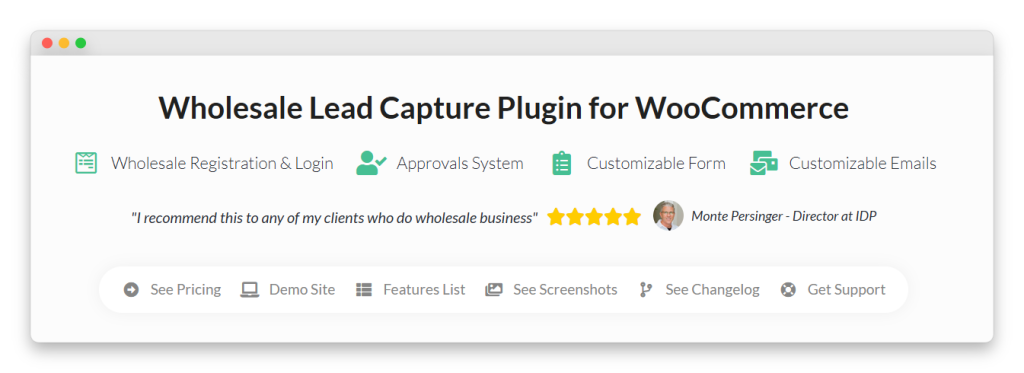
This information gets attached to the buyer’s wholesale account in WooCommerce. When they submit a quote request (your PO equivalent), you already have everything you need to process it without back-and-forth emails.
Think of it this way: Lead Capture is the onboarding step that happens once, before any POs flow. It saves you from chasing down a buyer’s tax ID or shipping address every time they submit an order. The more complete the profile, the faster you can process their purchase orders.
Complementary approach: The purchase order payment gateway
If you are looking for a different angle, the Wholesale Suite blog also has a guide on setting up a purchase order payment gateway. That approach adds “Purchase Order” as a payment method at checkout, allowing buyers to enter a PO number during the standard WooCommerce checkout flow.
The two approaches complement each other:
- Quote-to-order workflow (covered in this article): Best for stores where buyers submit PO requests that need admin review and approval before becoming orders.
- PO payment gateway: Best for stores where buyers self-serve through the catalog and only need to reference a PO number at checkout, rather than paying immediately.
Some stores run both, depending on the buyer relationship and order size.
Best Practices For Managing WooCommerce Purchase Orders
A few habits keep WooCommerce purchase orders organized as your wholesale business scales.
Keep a PO reference log
Every purchase order should be trackable from submission to payment. Maintain a simple log (even a spreadsheet works) that maps:
- PO number (from the buyer)
- WooCommerce order number
- Invoice number
- Payment status and due date
This makes it straightforward to answer questions like “What happened to PO #4521?” without digging through emails.
Document payment terms before the first order
Do not assume payment terms. Before a new wholesale buyer submits their first PO, confirm in writing:
- NET 30, 60, or 90?
- Early payment discounts (if any)?
- Late payment penalties?
- Credit limits?
According to Intuit QuickBooks’ 2025 small business late payments report, 56% of small businesses reported being owed money on unpaid invoices, with an average of $17,500 per business. Clear terms documented upfront reduce disputes later.
Match invoices to PO numbers
When you send an invoice through Wholesale Payments, always reference the buyer’s original PO number. This sounds obvious, yet it is the number one source of payment delays. The buyer’s accounts payable team needs to match your invoice to their internal PO before they can release payment.
Handle discrepancies immediately
If a buyer’s PO lists a price or quantity that does not match what you have agreed to, flag it before fulfilling the order. The quote review step in Wholesale Quotes gives you a natural place to catch these issues. Adjust the quote, communicate the change, and get confirmation before converting it to an order.
Set credit limits for new buyers
Not every wholesale buyer should get unlimited NET 30 terms on day one. Start new accounts with a conservative credit limit and raise it as the relationship builds. For example, a new buyer might begin with a $5,000 credit limit on NET 30 terms. After three orders paid on time, you increase it to $15,000.
This protects your cash flow while still offering the payment flexibility that purchase order buyers expect. You can track outstanding balances through your WooCommerce order records and the invoicing data in Wholesale Payments.
Create a PO terms template
Draft a standard document outlining how your PO process works. Include it in your wholesale onboarding materials or attach it to the welcome email sent after a buyer’s application is approved. Cover the basics:
- How to submit a PO (through the quote request form on your site)
- Expected turnaround time for PO review and approval
- Payment terms and due dates
- Return and cancellation policies for PO-based orders
- Contact information for your accounts receivable team
Having this documented means fewer misunderstandings and faster processing for both sides.
Start Accepting WooCommerce Purchase Orders Today
Purchase orders are how wholesale buyers prefer to do business. They provide a documented paper trail, support deferred payment terms, and fit the internal procurement processes that B2B buyers rely on. Meeting buyers where they already operate removes friction from your largest orders, and that often makes the difference between winning a wholesale account and losing it to a competitor who made buying easier.
You do not need a custom-built system to handle WooCommerce purchase orders. The combination of Wholesale Quotes for the request-to-order workflow, Wholesale Payments for NET-terms invoicing, and Lead Capture for collecting business details upfront provides a practical, structured approach. Start conservatively with credit limits, document your terms clearly, and keep every PO matched to its order and invoice, and you will have a system that scales smoothly as your wholesale business grows.
Here is what we covered about WooCommerce purchase orders in this article:
- What is a purchase order in wholesale
- How WooCommerce purchase orders work
- Setting up a WooCommerce purchase orders workflow with Wholesale Suite
- Best practices for managing WooCommerce purchase orders
Ready to give your wholesale buyers the PO workflow they expect? Get started with the Wholesale Suite bundle and set up your quote-to-order and NET terms invoicing today.
Frequently Asked Questions
What is the difference between a purchase order and a quote?
A purchase order is a buyer-initiated commitment to purchase specific products at agreed prices. A quote is a seller-initiated offer with proposed pricing. In practice, the mechanics are similar: both involve a request, a review, and an order creation. The quote workflow in Wholesale Suite handles both directions of this exchange.
Can I accept purchase orders and regular checkout orders simultaneously?
Yes. Your wholesale store can support both workflows at once. Buyers who want to self-serve can use the standard WooCommerce checkout with wholesale pricing applied. Buyers who prefer the PO process can submit quote requests through Wholesale Quotes. You can also add a PO payment gateway at checkout for buyers who want to reference a PO number during regular ordering.
How do I handle WooCommerce purchase orders with NET payment terms?
Wholesale Payments integrates NET 30/60/90 invoicing through Stripe. After fulfilling a PO-based order, the invoice is sent to the buyer with the agreed payment terms, and the buyer pays within those terms. For a deeper explanation of how B2B invoicing works, check out the beginner’s guide on the Wholesale Suite blog.
What if a buyer’s purchase order does not match the agreed pricing?
This is exactly why the quote review step matters. When a buyer submits a request through Wholesale Quotes, you review the details before it becomes an order. If quantities or pricing do not match, you adjust the quote, communicate the change, and get the buyer’s confirmation before converting it.