
Quick answer on how to sell wholesale: You need to choose your products, set wholesale pricing (typically 50% off retail), find retail buyers, set minimum order quantities, and bring your operations online. The fastest way to get started is with WooCommerce and a B2B plugin like Wholesale Suite, which handles pricing tiers, order forms, and payment terms automatically.
Starting a wholesale business is one of the most reliable ways to build a scalable, sustainable income, but only if you approach it with a clear plan.
According to Digital Commerce 360’s 2026 B2B Ecommerce Market Forecast, US B2B ecommerce grew 13% to $2.93 trillion in 2025, and more than 90% of B2B transactions are now electronic. Globally, the B2B ecommerce market is projected to reach around $36 trillion in 2026, roughly several times larger than the B2C ecommerce market. The buyers are online, spending, and looking for suppliers like you.
This guide walks you through every step of launching a wholesale business, from choosing products to setting up your online store and landing your first retail accounts. We have included a downloadable checklist at the end to help you track your progress as you learn to sell wholesale in your own market.
Why Sell Wholesale: Key Advantages
Before diving into the mechanics of how to sell wholesale, it helps to understand why this model is so attractive compared to pure retail. Five advantages stand out.
1. Predictable, recurring revenue
Retail buyers who find a reliable supplier tend to reorder consistently. This creates a more predictable revenue stream compared to retail, where every sale requires finding a new customer. Forrester Research confirms that 61% of B2B revenue comes from existing customers through renewals and expansion, which means your repeat-buyer base becomes your most valuable asset over time.
2. Higher order values
A single wholesale order might be worth what 50 to 100 individual retail sales would generate. Fewer transactions to manage means lower customer acquisition costs per revenue dollar. Shopify’s B2B trends report notes that the number of B2B decision-makers willing to spend $10 million or more on a single ecommerce transaction has increased by 83%, showing just how high order values have climbed in digital wholesale.
3. Lower marketing costs
In wholesale, you market to dozens of business buyers rather than thousands of individual consumers. Your cost per acquisition is significantly lower, and relationship-based selling replaces the need for constant advertising. For a two-sided economics comparison, see our guide on wholesale vs retail.
4. Faster inventory turnover
Selling in bulk means your inventory moves faster, freeing up capital for new products and reducing storage costs. Fast inventory turnover is one of the key metrics that separates profitable wholesalers from struggling ones. Bulk orders also give you better leverage with your own suppliers, since you can negotiate based on predictable volume.
5. Scalable business model
Adding new retail accounts is more scalable than finding individual retail customers. Each new retail buyer represents ongoing bulk orders, not a one-time purchase. Once you learn to sell wholesale systematically, growth becomes a matter of repeating the same outreach and onboarding process with new accounts, rather than reinventing the wheel for each buyer.
How To Sell Wholesale: 8 Steps To Get Started
These eight steps walk you through everything you need to launch a wholesale operation, from picking products to landing your first reorder. Follow them in sequence for the smoothest path to your first wholesale invoice.
Step 1: Choose your wholesale products
Your product choice determines everything. Margins, customers, startup costs, and competitive position all flow from this decision. When evaluating products for a wholesale business, consider:
- Margin viability: Aim for a minimum 30% gross margin after all costs (product, shipping, storage, returns)
- Demand consistency: Products with year-round demand provide more stable income than seasonal products
- Supplier availability: Can you find multiple reliable suppliers? Depending on a single supplier is risky
- Competition level: Underserved niches often offer better opportunities than crowded categories
The strongest wholesale product categories in 2026 include beauty products (50% to 80% margins), jewellery (50% to 75% margins), pet supplies (40% to 60% margins), and apparel (40% to 60% margins). See our complete breakdown of the best wholesale items to sell for detailed data on each category.
Step 2: Set your wholesale pricing strategy
The standard wholesale pricing formula is:
Wholesale Price = Retail Price × 0.50
However, this is a starting point, not a rule. Your actual wholesale price depends on your cost of goods (COGS), the margins your retail buyers require (typically 50% to 100% markup), your overhead costs (storage, shipping, staff, technology), and competitive pricing in your product category.
Many successful wholesalers use tiered pricing, where the more a buyer orders, the lower the per-unit price. Wholesale Prices Premium handles this with quantity-tier rules you set once per product, role, or category. This incentivizes larger orders and rewards your best customers.
Use our free wholesale price calculator to model different pricing scenarios and find the sweet spot that works for both you and your buyers. For a complete pricing guide, see our wholesale price guide and our wholesale discount reference.
Step 3: Set minimum order quantities (MOQs)
MOQs protect your margins and ensure each order is worth processing. Without MOQs, you will waste time and money fulfilling small orders that do not cover your costs.
When setting MOQs, consider your break-even point (what minimum order size covers your fulfilment costs?), your buyers’ capacity (set MOQs that are achievable for your target retailers without requiring them to take on excessive risk), and industry standards (research what competitors offer and stay competitive).
Learn more about setting the right MOQ in our minimum order quantity guide and our minimum order requirements guide.
Step 4: Build your supplier network
Whether you are manufacturing your own products or sourcing from other manufacturers, having reliable suppliers is the foundation of your wholesale business.
Finding suppliers: Industry trade shows (the best way to verify quality firsthand), wholesale directories like Alibaba for international or ThomasNet for US domestic, direct manufacturer outreach, and industry associations and trade organisations.
Vetting suppliers: Request samples before committing to orders. Verify certifications and compliance documentation. Check lead times and consistency. Understand their return and defect policies. Ask for references from other wholesale clients.
For a comprehensive supplier directory, see our guide to the best wholesale suppliers.
Step 5: Bring your wholesale business online
The most efficient way to run a modern wholesale business is through an online store. Going digital lets you reach buyers globally, automate pricing and ordering, process orders around the clock, and track inventory in one system. The market momentum is overwhelming here. According to McKinsey’s B2B Pulse Survey, 54% of B2B buyers switch suppliers when they experience a poor digital customer experience, so being online is no longer optional.
WooCommerce is the most popular platform for wholesale stores because it is flexible, affordable, and has a massive ecosystem of extensions. To add wholesale capabilities to WooCommerce, you need a dedicated B2B plugin.
Easily add a wholesale power tool to your store
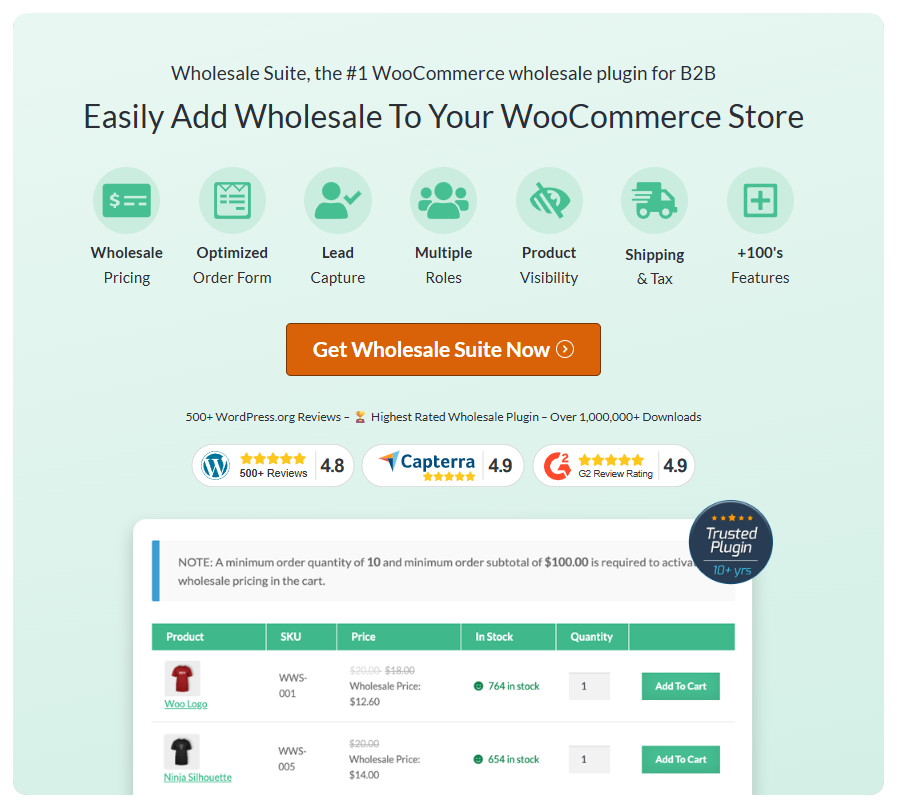
Wholesale Suite is the leading wholesale solution for WooCommerce, giving you everything you need to learn how to sell wholesale efficiently:
- Prices Premium sets different pricing tiers for different customer groups. Create wholesale, distributor, and VIP pricing levels with automatic discounts.
- Order Form gives your buyers a streamlined, single-page ordering experience. They can browse your full catalog and add quantities without navigating between product pages.
- Lead Capture automates your customer onboarding. New buyers apply through a registration form, you approve or deny, and they are assigned the right pricing tier automatically.
- Payments offers NET 30, NET 60, or NET 90 invoice payment terms. This is standard in B2B and a requirement for most serious retail buyers.
- Quotes, the newest addition to the family, lets buyers request a quote from your catalog, negotiate through a built-in messaging thread, and convert approved quotes to orders with one click.
Once buyers start using Quotes to negotiate, you’ll want a repeatable process for deciding when to say yes — our guide to B2B price negotiation covers how to evaluate requests and protect your margins. Wholesale Prices Premium now also includes the new Wholesale Reports dashboard, which provides live visibility into total wholesale revenue, top products, category performance, average order value, and unique customer trends, all filtered by date range and wholesale role.
Step 6: Create your wholesale terms and conditions
Clear terms and conditions protect both you and your buyers. Your wholesale T&C should cover payment terms (NET 30, NET 60, prepayment requirements), minimum order quantities, shipping responsibilities and costs, return and defect policies, territory restrictions if applicable, and pricing adjustment policies.
For a detailed guide on creating wholesale terms, see our wholesale terms and conditions guide.
Step 7: Find your first retail buyers
Landing your first wholesale accounts takes hustle, but once you have a few reordering buyers, growth becomes more predictable. Proven strategies for finding retail buyers include:
- Trade shows: The most effective way to meet buyers face-to-face and demonstrate your products
- Direct outreach: Identify retailers who sell similar products and reach out with a compelling pitch
- Online marketplaces: List your wholesale offerings on B2B marketplaces like Faire or Alibaba
- Social proof: Once you have a few retail accounts, use them as references to land more
- Your online wholesale store: Make it easy for buyers to find you through search and apply for wholesale accounts through your site
For more strategies, see our guide on how to sell to retailers and attracting wholesale customers.
Step 8: Scale your operations
Once you have a handful of consistent retail buyers, focus on scaling your wholesale business:
- Expand your product catalog based on what is selling best
- Add new pricing tiers to reward your highest-volume buyers
- Automate more processes, including order confirmations, payment reminders, and inventory alerts
- Explore new markets, such as international buyers, different retail segments, or direct-to-consumer, alongside wholesale
For 30 actionable tactics to grow your wholesale revenue, see our 30 growth hacks to increase wholesale sales.
Common Mistakes To Avoid When Learning How To Sell Wholesale
Even with a clear plan, new wholesalers often stumble on the same pitfalls. Knowing these in advance saves you months of frustration as you figure out how to sell wholesale profitably.
Pricing too low to win early buyers
Aggressive early pricing trains your buyers to expect rock-bottom rates, and raising prices later feels like a betrayal. Start with defensible pricing that gives your retail buyers the 50%-100% markup they need, and let your product quality do the selling.
Ignoring payment terms
Most serious retail buyers expect NET 30 or NET 60 terms rather than upfront payment. Refusing to offer terms dramatically narrows your buyer pool. Using a plugin like Wholesale Payments makes NET terms automatic and professional rather than a manual headache.
Treating wholesale like retail with bigger orders
Wholesale buyers need different things than retail shoppers. They want fast reorder flows, SKU-based search, bulk quantity entry, clear pricing visibility, and dedicated account management. A standard WooCommerce shop page does not deliver this. A dedicated wholesale order form does.
Neglecting data and reporting
Without clear reporting, you cannot see which products, categories, or buyer tiers are actually driving your revenue. Modern wholesale platforms should include reports that show wholesale vs retail splits, top products by revenue and volume, and customer retention trends. Our guide on building a WooCommerce wholesale sales report walks through exactly which metrics to track and how to pull them using Wholesale Suite and WooCommerce Analytics.
Forgetting to follow up for reorders
A wholesale buyer who orders once and never reorders is just an expensive retail customer. Build a simple follow-up cadence: 7 days after delivery (check satisfaction), 30 days after delivery (prompt reorder), and 60 days after delivery (send a special offer if they have not reordered).
Wholesale Startup Checklist
Use this checklist to track your progress as you launch your wholesale business:
Your wholesale launch checklist:
- Research and select your product category
- Source and vet at least 2 to 3 potential suppliers
- Request and evaluate product samples
- Calculate your wholesale pricing using our pricing calculator
- Set your minimum order quantities
- Draft your wholesale terms and conditions
- Set up your WooCommerce store with quality hosting
- Install and configure Wholesale Suite
- Create your wholesale pricing tiers
- Set up your wholesale registration form
- Configure payment terms (NET 30/60/90)
- Build your wholesale order form
- Enable the Wholesale Reports dashboard
- Create product photography and descriptions
- Identify your first 10 target retail buyers
- Prepare your outreach pitch and product samples
- Reach out to your first target buyers
- Process your first wholesale order
- Follow up for reorders within 30 days
Conclusion
Learning how to sell wholesale is one of the most reliable paths for a retail-focused operator to build a scalable, recurring-revenue business.
Pair WooCommerce with a purpose-built B2B toolkit like Wholesale Suite, automate the tedious parts (pricing, onboarding, payment terms, reporting), and spend your time on the work that actually moves the business forward: finding great products, building supplier relationships, and closing retail accounts.
In this guide, we walked through everything you need to know about launching a wholesale business:
- Why sell wholesale: key advantages
- How to sell wholesale: 8 steps to get started
- Common mistakes to avoid when learning how to sell wholesale
- Wholesale startup checklist
Start with the product category that excites you most and offers a defensible margin, calculate your pricing with our free wholesale price calculator, and reach out to your first 10 target buyers. For additional strategies on growing your operation after launch, check out our guides on 30 growth hacks to increase wholesale sales and streamlining your wholesale operations.
Frequently Asked Questions
How much does it cost to start a wholesale business?
Most wholesale businesses can start with $2,000 to $15,000 for initial inventory, depending on the product category. Jewellery, beauty products, and accessories have the lowest entry costs. Beyond inventory, budget $500 to $2,000 for your WooCommerce store setup (hosting, domain, and a wholesale plugin like Wholesale Suite). The total startup cost for a basic wholesale operation ranges from $2,500 to $17,000.
What’s the difference between wholesale and retail pricing?
Wholesale pricing is typically 50% of the retail price, though this varies by industry and product category. The standard formula is Wholesale Price = Retail Price × 0.50, which gives the retailer enough margin (50% to 100% markup) to cover their own costs while remaining profitable. Your actual wholesale price should be calculated based on your cost of goods, overhead, and competitive positioning.
Do I need a license to sell wholesale?
Requirements vary by location. In the United States, most states require a wholesale or reseller license (sometimes called a resale certificate or sales tax permit). This allows you to purchase inventory without paying sales tax, which your retail buyers collect when they sell to end consumers. Check your state’s requirements through your Secretary of State’s office or Department of Revenue.
Can I sell wholesale and retail at the same time?
Yes, and many businesses do exactly that. The key is maintaining price separation, where your retail customers should not have access to your wholesale pricing, and your wholesale buyers should trust that you are not undercutting them by selling retail at or near wholesale prices. Wholesale Prices Premium handles this automatically by showing different prices to different customer groups on the same WooCommerce store.
How do I handle wholesale payments?
Most wholesale transactions use invoice-based payment terms (NET 30, NET 60, or NET 90), meaning the buyer has 30, 60, or 90 days to pay after receiving their order. This is standard in B2B and expected by most retail buyers. Wholesale Payments adds invoice payment terms to WooCommerce, making this process automatic rather than manual.
How long does it take to land my first wholesale buyer?
Most new wholesalers land their first paying account within 30 to 90 days of launch, assuming they do active outreach. Trade shows produce the fastest results because buyers come pre-qualified and ready to evaluate suppliers. Cold outreach and inbound from your website take longer but compound over time as your reputation grows.
Can I learn how to sell wholesale without a warehouse?
Yes. Many successful wholesalers start with dropshipping or on-demand manufacturing arrangements where the supplier ships directly to the retail buyer. You handle the relationship and the order processing, while the supplier handles fulfilment. The tradeoff is slightly lower margins in exchange for near-zero inventory risk.