
Most wholesale store owners can tell you exactly what their average order is worth. Ask them what a single wholesale customer is worth over a relationship that can run three, four, or five years, though, and the answer usually goes quiet. That number is your wholesale customer lifetime value (CLV), one of the most important metrics in B2B.
It tells you how much you can afford to spend acquiring new wholesale customers and how much you should invest in keeping the ones you already have. Without it, you are making acquisition and retention decisions based on individual orders instead of the full picture.
This guide breaks down what wholesale customer lifetime value actually is, how to calculate it with a simple formula, why it matters more for wholesale than retail, and five practical strategies you can use with Wholesale Suite to increase it.
What Is Wholesale Customer Lifetime Value?
Wholesale customer lifetime value is the total revenue a single wholesale customer generates over their entire relationship with your business. Instead of looking at the value of a single order, CLV looks at what the customer is worth across all the orders they will ever place with you.
In retail, CLV calculations deal with high customer counts, low average order values, and unpredictable purchase patterns. Wholesale CLV is a different animal. Your wholesale customers typically place larger orders, buy on a more predictable schedule (monthly or quarterly), and maintain relationships that span years rather than months.
According to Bain & Company, increasing customer retention rates by just 5% can increase profits by 25% to 95%. In wholesale, where each customer relationship can be worth tens of thousands of dollars, that retention premium is even more pronounced.
Because CLV connects your acquisition spending, retention efforts, and pricing into a single number, it serves as a north star metric for the whole business. It answers the question every wholesale store owner should be asking: how much is this customer relationship actually worth?
How To Calculate Wholesale CLV (With Formulas)
The simple wholesale CLV formula
The most straightforward way to calculate wholesale customer lifetime value is:
CLV = Average Order Value x Purchase Frequency x Customer Lifespan
Here is what each variable means in a wholesale context:
- Average Order Value (AOV): The average dollar amount per wholesale order. Pull this from your WooCommerce order reports, filtered to wholesale customers only.
- Purchase Frequency: How many orders a wholesale customer places per year. Some wholesale buyers order monthly, others quarterly, and some place a few large orders annually.
- Customer Lifespan: The average number of years a wholesale customer stays active before they stop ordering. If you do not have historical data yet, estimate conservatively. Two to three years is a reasonable starting point for newer wholesale businesses.
A worked example (illustrative data)
Here is what this looks like in practice (example data):
Say your average wholesale customer places orders worth $2,000 each, orders once per month (12 times per year), and stays with you for 3 years.
CLV = $2,000 x 12 x 3 = $72,000
That single wholesale customer is worth $72,000 over the course of the relationship. Now look at what happens when you improve just one variable:
- Increase AOV to $2,500: CLV jumps to $90,000
- Increase frequency to 14 orders per year: CLV jumps to $84,000
- Extend lifespan to 4 years: CLV jumps to $96,000
Note: These are illustrative figures meant to demonstrate the formula. Your actual numbers will depend on your products, pricing, and customer behavior.
Small improvements to any one of these variables create a significant lift in total customer value. That is why wholesale customer lifetime value is such a powerful planning tool rather than just a reporting metric.
Where to find your numbers
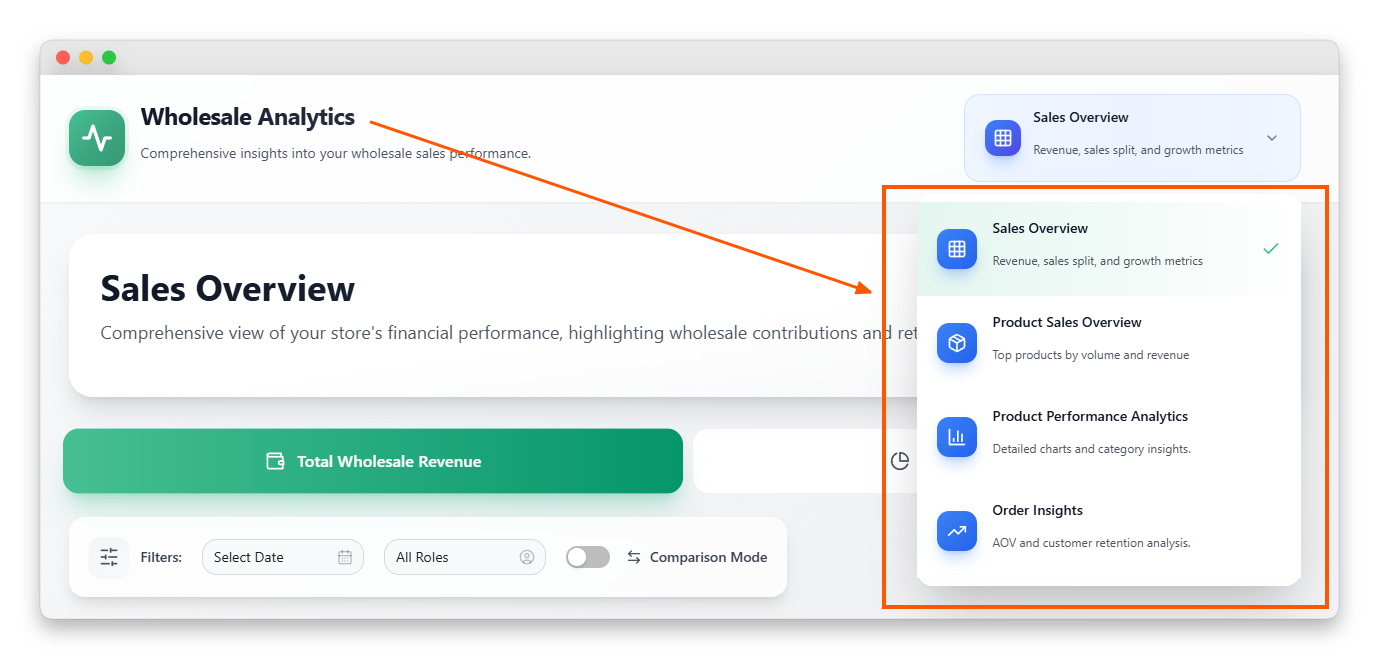
WooCommerce’s built-in reports show your order totals and customer purchase history. If you are using Wholesale Prices Premium, its wholesale sales reports let you separate wholesale revenue from retail revenue, which gives you cleaner data for your CLV calculation.
To be clear, there is no automated CLV calculator built into Wholesale Suite or WooCommerce. You will need to pull the data from your reports and calculate wholesale customer lifetime value manually using a spreadsheet or the formula above. The value of the wholesale sales reports is that they give you wholesale-specific numbers to work with, rather than blending wholesale and retail data together.
If you want a broader view of the numbers that drive a B2B store, our guide to the B2B metrics every wholesale business should track puts CLV alongside the other figures worth watching.
What we have seen: Store owners almost always track their average order value, but very few take the next step of calculating lifetime value. This leads to a common mistake, which is undervaluing retention. When you think in terms of individual orders, spending $500 to retain a customer feels expensive. When you know that customer is worth $72,000 over three years, that same $500 looks like one of the best investments you can make.
Why CLV Matters More For Wholesale Than Retail
Wholesale customer lifetime value carries more weight than retail CLV for three reasons.
First, the per-customer revenue is dramatically higher. In retail, losing a customer who spends $50 per order is a minor event. In wholesale, losing a customer who spends $2,000 per order, 12 times a year, means losing $24,000 in annual revenue. Multiply that across two or three churned accounts, and the impact on your bottom line is severe.
Second, wholesale acquisition costs are higher. Winning a new wholesale account often involves trade shows, sales outreach, sample shipments, credit applications, and a longer evaluation process. According to Harvard Business Review, acquiring a new customer costs anywhere from 5 to 25 times more than retaining an existing one. In wholesale, where the sales cycle is longer and more resource-intensive, the cost multiplier tends to be at the higher end of that range.
Third, wholesale businesses typically operate with fewer customers, each of whom carries outsized importance. A retail store with 5,000 customers can absorb the loss of a few dozen without noticing. A wholesale business with 50 accounts cannot afford to lose even two or three without feeling it. The more concentrated your revenue is across fewer customers, the more each customer’s lifetime value matters.
Understanding these dynamics changes how you allocate your budget. Instead of pouring most of your resources into acquiring new accounts, you start investing proportionally in retaining the wholesale customers you already have.
5 Ways To Increase Wholesale Customer Lifetime Value
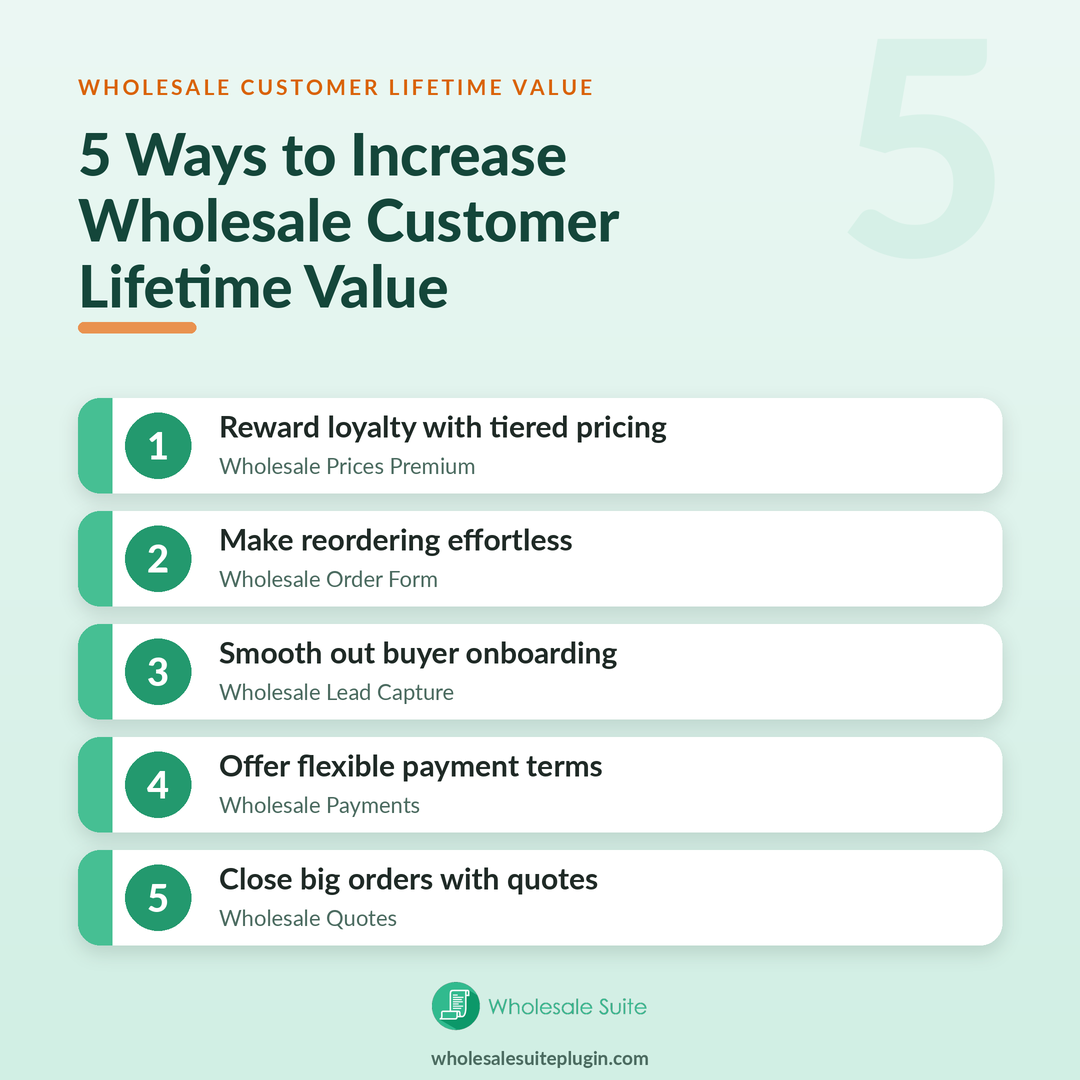
Wholesale customer lifetime value improves when you increase any of the three variables: average order value, purchase frequency, or customer lifespan. Here are five strategies that target all three, each tied to a specific capability in Wholesale Suite.
Offer tiered pricing that rewards loyalty
Tiered pricing gives wholesale customers a reason to order more and stay longer. When you set up pricing tiers that reward higher volumes or longer relationships, you create an incentive structure where customers earn better rates as they grow with you.
For example, you might offer a standard wholesale tier at 20% off retail and a VIP tier at 30% off for customers who have been active for over a year or who exceed a certain order threshold. Wholesale Prices Premium lets you create multiple wholesale roles, each with its own pricing, which makes it straightforward to build a tiered system that rewards loyalty.
According to McKinsey & Company, top-performing loyalty programs can boost revenue from participating customers by 15% to 25% annually, usually by lifting purchase frequency, order size, or both. Tiered wholesale pricing taps into the same principle. Even without a formal points-based program, it gives your best customers a tangible reason to keep ordering with you.
The more a customer benefits from their current tier, the less likely they are to switch to a competitor and start over at a lower discount level. For more on keeping those buyers coming back, see our guide to building B2B customer loyalty in wholesale.
Streamline reordering with one-page order forms
The easier it is to reorder, the more often customers will do it. If your wholesale buyers have to browse your full catalog every time they want to place a repeat order, you are adding friction that quietly reduces purchase frequency.
Wholesale Order Form gives your customers a single-page ordering experience where they can see your entire product catalog (or a filtered subset), enter quantities for multiple products at once, and submit the order in one step. For wholesale buyers who regularly reorder the same products, this is dramatically faster than navigating product pages one by one.
Reducing ordering friction directly increases purchase frequency, and higher purchase frequency is one of the fastest ways to lift your wholesale customer lifetime value.
Improve onboarding to reduce early churn
Many wholesale relationships fall apart in the first 90 days. A new wholesale customer signs up, places one or two orders, runs into friction such as confusing pricing or a slow approval process, and quietly stops ordering. You never hear from them again.
A smooth onboarding process prevents this. Wholesale Lead Capture lets you build a registration and approval workflow in which new buyers apply for a wholesale account, you review and approve them, and they immediately gain access to their wholesale pricing and ordering tools.
The first few interactions set the tone for the entire relationship. When onboarding is smooth, customers are far more likely to become recurring customers who stay with you for years. When it is confusing, they will find another supplier.
Offer flexible payment terms to reduce friction
Payment friction is one of the most common reasons wholesale customers reduce their order frequency or leave entirely. Requiring prepayment on every order may feel safe to you, but it is inconvenient for buyers accustomed to Net 30 or Net 60 terms from other suppliers.
Wholesale Payments gives you control over which payment methods wholesale customers can use and lets you configure terms that match B2B expectations, including NET 30, 60, or 90 invoicing powered by Stripe. Offering invoice-based payments or net terms removes the friction that can slow down reorders.
When ordering and paying are both easy, customers order more often and stick around longer, and both outcomes directly feed into your wholesale customer lifetime value.
Use quote workflows for custom deals on large orders
Your highest value wholesale customers are often the ones who need custom pricing for large or non-standard orders. If they cannot easily request a quote and negotiate terms, they may take that large order to a competitor who can.
Wholesale Quotes lets customers submit quote requests for specific products and quantities. You can review the request, offer a custom price, and the customer can accept and check out directly from the approved quote. This keeps your standard wholesale pricing intact while giving you flexibility on high-value deals.
Quote workflows protect your largest accounts and open the door to bigger orders, both of which increase your wholesale customer lifetime value.
Ready to put all five strategies to work? Wholesale Suite bundle includes Prices Premium, Order Form, Lead Capture, Wholesale Payments, and Wholesale Quotes in a single package.
How To Track Wholesale CLV In WooCommerce
Tracking wholesale customer lifetime value requires pulling data from your store’s reports and doing some calculation outside of WooCommerce.
Start with WooCommerce’s built-in order reports. You can filter by customer to see their total order history, order count, and average order value. If you are using Wholesale Prices Premium, its wholesale sales reports separate wholesale orders from retail orders, which gives you cleaner data to work with.
From there, the process looks like this:
- Export your wholesale customer order data, or compile it manually from WooCommerce reports
- Calculate your average wholesale order value across all wholesale customers
- Calculate your average purchase frequency (orders per year per customer)
- Estimate your average customer lifespan (how long wholesale customers stay active)
- Apply the formula: CLV = AOV x Purchase Frequency x Customer Lifespan
To be straightforward, there is no built-in CLV dashboard in WooCommerce or Wholesale Suite that does this automatically. You will need a spreadsheet, or you can connect your WooCommerce data to an analytics tool like Google Analytics or a dedicated CRM that supports CLV calculations.
The good news is that wholesale businesses typically have fewer customers and more consistent ordering patterns than retail stores, which makes the manual calculation manageable. Even calculating wholesale customer lifetime value for your top 20 accounts will give you actionable insight into where to focus your retention efforts.
For more strategies on improving the revenue side of your operation, take a look at our guide on how to boost your wholesale margins.
Start Tracking Your Wholesale Customer Lifetime Value
Once you know your wholesale customer lifetime value, you stop making decisions based on individual orders and start thinking in terms of customer relationships. That shift changes everything: how much you spend on acquisition, how much you invest in retention, and how you structure your pricing. The math rewards patience, because the biggest gains come from small, compounding improvements to order value, frequency, and lifespan rather than from chasing one more new account.
The practical path forward is simple. Pull your wholesale numbers, run them through the formula, and then pick one or two of the strategies above to focus on first. Most store owners find that streamlining reordering and tightening up onboarding deliver the fastest, most visible lift, while tiered pricing and flexible payment terms compound quietly over the following quarters.
Here is what we covered in this article:
- What is wholesale customer lifetime value
- How to calculate wholesale CLV (with formulas)
- Why CLV matters more for wholesale than retail
- 5 ways to increase wholesale customer lifetime value
- How to track wholesale CLV in WooCommerce
If you are ready to start increasing your wholesale customer lifetime value, Wholesale Suite gives you the tools to execute every strategy in this guide. Explore the bundle and see how it fits your wholesale operation.
Frequently Asked Questions
What is a good wholesale customer lifetime value?
There is no single benchmark, because CLV varies widely by industry, product type, and pricing model. A wholesale business selling consumable products like food or packaging supplies will typically see higher purchase frequency and shorter lifespans, while a business selling durable goods may see fewer orders over a longer relationship. The more useful question is whether your wholesale customer lifetime value is trending upward over time as you invest in retention and reduce churn.
How often should I recalculate my wholesale CLV?
Recalculate quarterly, or at least twice a year. This lets you spot trends early. If your CLV is declining, it usually means one of the three variables (order value, frequency, or lifespan) is dropping. Quarterly reviews give you time to identify the cause and adjust before the impact compounds.
Can I calculate CLV automatically in WooCommerce?
WooCommerce does not include a built-in CLV calculator, and neither does Wholesale Suite. You can pull the necessary data from WooCommerce order reports and Wholesale Prices Premium’s wholesale sales reports, but the actual calculation needs to happen in a spreadsheet or an external analytics tool. Some CRM integrations can automate this once you connect your WooCommerce order data.
What is the difference between wholesale CLV and retail CLV?
The main differences are scale and predictability. Wholesale CLV is typically much higher because order values are larger and relationships last longer. Retail CLV deals with many more customers making smaller, less predictable purchases. The formula is the same, but the inputs differ, and the strategic stakes are bigger for wholesale because each customer represents a larger share of total revenue.