

If you bought a B2B pricing extension and then discovered you still cannot approve wholesale applications, take bulk orders, or offer payment terms, you bought a plugin that solves ONLY one of the five jobs a wholesale operation needs. That gap is why so many store owners start looking for a B2B pricing extension alternative a few months after checkout.
That sequence is common enough to plan for. Below are the four jobs a pricing plugin leaves untouched, and the B2B pricing extension alternative options that actually cover them.
What The Marketplace B2B Pricing Extensions Do Well
The B2B pricing extensions sold through the official WooCommerce marketplace do exactly what they say. They apply different prices to different customer groups without touching your retail prices.
Credit where it is due. Group and role-based pricing rules work reliably, distribution through the official marketplace means predictable compatibility with WooCommerce core updates, and for a store whose only requirement is that wholesale customers see lower prices, that is the whole job.
The problem is not quality. It is scope, and specifically the fact that scope is invisible at the point of purchase. Anyone shopping for a B2B pricing extension alternative is usually reacting to that discovery rather than to a defect. If the extension you bought was Wholesale for WooCommerce, our guide to the best Wholesale for WooCommerce alternatives works through the same gap plugin by plugin.
The channel these tools serve is not small. U.S. merchant wholesalers recorded sales of $11,382.3 billion in 2022, a 17.4% increase over 2021, according to the U.S. Census Bureau’s Annual Wholesale Trade Survey. Looking further forward, Digital Commerce 360 puts U.S. manufacturing and wholesale distribution sales at $15.12 trillion in 2025 using Department of Commerce data, and notes that while the overall top line has been close to flat since 2022, digital transactions keep expanding at a double-digit pace.
Buying behavior is shifting into self-service channels faster than total demand is growing, which means the ordering and payment side of your store is where the pressure lands first.
The Four Jobs A B2B Pricing Extension Is Expected To Do
A working wholesale operation has five jobs. Pricing is one of them, and it is the easiest one.
Getting the price right still matters, because wholesale margins leave almost no room for error. NYU Stern’s margins by sector dataset, updated in January 2026, puts the average net margin at 1.17% for food wholesalers and 6.05% for retail distributors. Manual corrections passed between disconnected tools eat into numbers that thin very quickly.
Getting wholesale customers in
Somebody has to apply; you have to check they are a real business, and their account has to be assigned the right role once approved. A pricing extension has no opinion on any of that. Without a registration and approval layer, you are vetting people manually from an inbox and hoping the correct role was applied.
Our guide to manual versus automated WooCommerce registration covers the approval side in detail.
Letting them order at volume
A wholesale buyer working through forty line items on retail product pages will stop using your store and email you a spreadsheet instead. This is the single most common reason a wholesale program quietly reverts to email.
Buyers are ready to self-serve at real scale. McKinsey’s 2026 Global B2B Pulse Survey, based on responses from nearly 4,000 decision-makers across 13 countries, found that 73% of B2B buyers are comfortable placing orders above $50,000 online, up from 59% in 2022. Whether your store lets them place that order is a question about ordering, not about price.
Getting paid on terms
Business customers frequently expect to pay after delivery rather than by card at checkout. Card-only checkout is a hard stop for a large part of the B2B market, and it has nothing to do with your prices.
Credit limits belong in this picture too, and we cover the mechanics in wholesale credit limits and NET terms approval.
Handling negotiated pricing
Large or custom orders need a number agreed before the order exists. Fixed tier pricing cannot express that, so the negotiation happens over email and outside any system. The same McKinsey research notes that buyers placing infrequent large orders lean heavily toward human interaction rather than pure self-service, which is precisely the conversation a quote workflow is built to hold.
The Best B2B Pricing Extension Alternatives
Each B2B pricing extension alternative below covers a different amount of that five-job list. Read them against the jobs you have already hit rather than against a feature grid.
Alternative 1: Wholesale Suite (best overall)
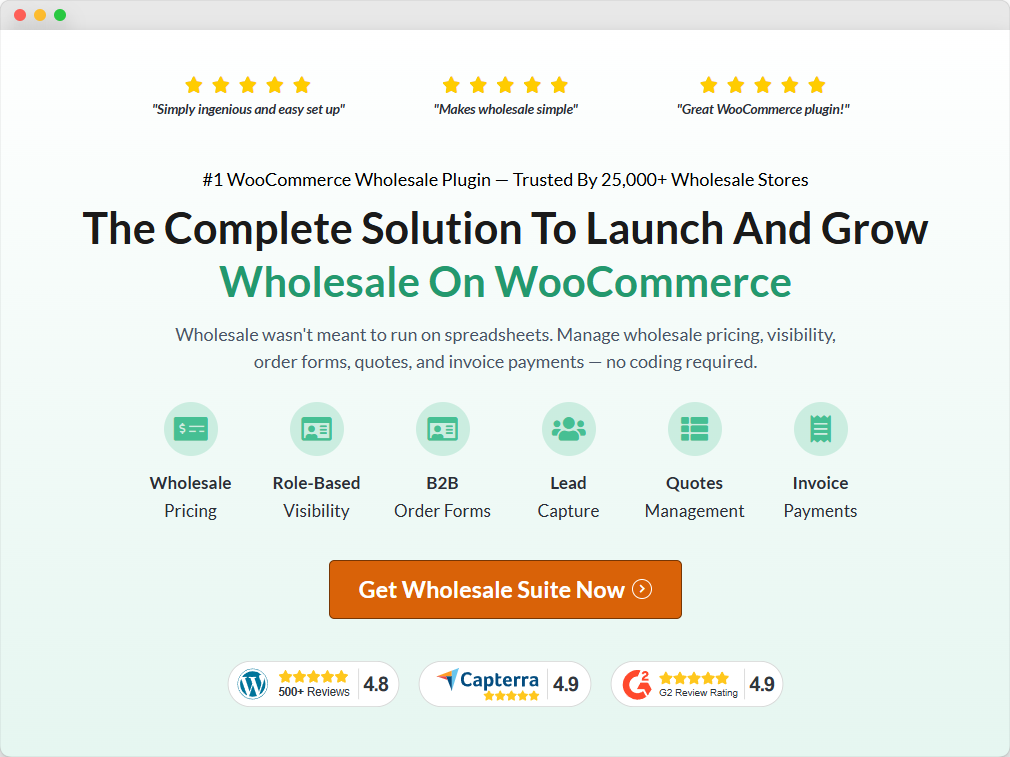
Wholesale Suite maps directly onto the five jobs, which is the reason to consider it over another pricing-only tool. It has been in the market for more than eight years and is used by over 25,000 stores.
Pricing is handled by Wholesale Prices Premium, with global, category, and per-product wholesale prices, quantity break points, unlimited wholesale roles, and minimum order requirements. Rule-based role automation can upgrade, downgrade, or pause customers between tiers based on how they spend and order, so tier management stops being a manual admin task.
Getting customers in is Wholesale Lead Capture, which gives you a registration form with custom fields, file upload for business documentation, and manual or automatic approval that assigns the role for you. Ordering at volume is the single-page Wholesale Order Form. Payment terms come from Wholesale Payments, which handles NET 30, 60, and 90 through Stripe invoicing. Negotiated pricing runs through Wholesale Quotes, with in-quote messaging, line-item adjustment, and one-click conversion into a WooCommerce order.
Pros:
- Covers all five jobs through one wholesale role system
- Approval workflow collects documentation rather than just an email address
- Real payment terms via Stripe, not an unpaid-order workaround
- Role automation moves customers between tiers without manual admin
- Free version available for the pricing layer alone
Cons:
- Five plugins rather than one install
- If pricing genuinely is your only gap, it is more than you need
Alternative 2: B2BKing
B2BKing puts the whole B2B feature set into a single plugin with unified rules, and it does that well.
The unification is a real strength when your main concern is having too many moving parts. It also includes enterprise-oriented features such as purchase-order checkout and company credit. The trade is breadth over depth, since covering that much ground in one plugin means each area tends to be competent rather than specialized.
Alternative 3: WholesaleX
WholesaleX focuses on dynamic pricing flexibility, a prepaid wallet, and a conversation-based negotiation flow, wrapped in a modern dashboard that is pleasant to work in day-to-day.
The wallet is the distinctive piece and suits stores whose buyers prepay against a balance. As the newest of the major options, it also has a shorter production track record than the alternatives that have been running in live stores for years.
Alternative 4: Barn2 Wholesale Pro
Barn2 Wholesale Pro is the tidiest B2B pricing extension alternative for a store that wants registration and role-based pricing without a larger system around it.
Payment terms and negotiated quoting sit outside its scope, so if those are on your roadmap this becomes a staging post rather than a destination.
What It Costs To Assemble The Same Thing
Compare total cost of ownership rather than sticker price, because the sticker price only covers job one. Assembling the same capability means buying a pricing plugin, a registration or form plugin, an ordering solution, an invoicing or payment-terms plugin, and a quote plugin. Five licenses, five renewal dates, five support queues, and the integration work between them are yours.
The integration work is the part that is hard to price in advance. When the quote plugin does not know what the pricing plugin decided, somebody corrects it by hand on every quote. That cost recurs weekly and never appears on an invoice.
Wholesale Suite is sold as a bundle covering all five jobs, with unlimited site usage and a 14-day money-back guarantee, so it is worth comparing the current bundle pricing against the sum of the separate tools before deciding.
For a look at what consolidation does in practice, we wrote up the B2B growth of a natural wellness brand that moved off manual WooCommerce user roles and separate discount codes, and now runs retail and wholesale through one system with far less admin work.
Choosing A B2B Pricing Extension Alternative
The useful reframe is to stop shopping for a pricing plugin and start counting how many of the five jobs you actually have. That number decides everything else, and it is a far better filter than any feature comparison. A store that has only ever needed lower prices for logged-in wholesale customers does not need a B2B pricing extension alternative at all, and nothing in this article should push it toward one.
Once you have hit two or more of the four jobs a pricing extension does not cover, though, the calculation changes. Buyers are increasingly comfortable transacting at scale online, margins in wholesale distribution are thin enough that manual reconciliation is expensive, and inconsistent customer information is now the leading reason B2B buyers walk. Every one of those pressure points points the same direction: toward fewer systems holding one shared definition of who your wholesale customer is and what they pay. Judge each B2B pricing extension alternative on whether it delivers that, then on price.
Wholesale Suite handles all five jobs through one role system, so approving a customer, pricing them, letting them order, and getting paid on terms become the same workflow rather than four separate ones. If you are somewhere earlier in that journey, the free pricing plugin is a low-risk place to start, and the rest can follow as the jobs arrive.
Here’s what we covered in this article:
- What the marketplace B2B pricing extensions do well
- The four jobs a B2B pricing extension is expected to do
- The best B2B pricing extension alternatives
- What it costs to assemble the same thing
Frequently Asked Questions
Do I have to remove the pricing extension I already bought?
Not immediately, but you should not run two plugins that both filter product prices for long, because they will eventually disagree. Plan a short overlap while you migrate roles and prices to your chosen B2B pricing extension alternative, then deactivate the old one.
Can I just add the missing pieces instead of switching?
You can, and some stores do. The question to ask is whether the pieces will share a customer role. If each plugin defines its own idea of who counts as a wholesale customer, you are maintaining that mapping by hand forever.
Will switching lose my existing wholesale prices?
Only if you skip the export. Wholesale prices live in plugin-specific fields, so export your products and users before you change anything and keep that file unedited as your rollback.